Marathon BIB Full Form: Meaning, Purpose and How Timing Chips Work
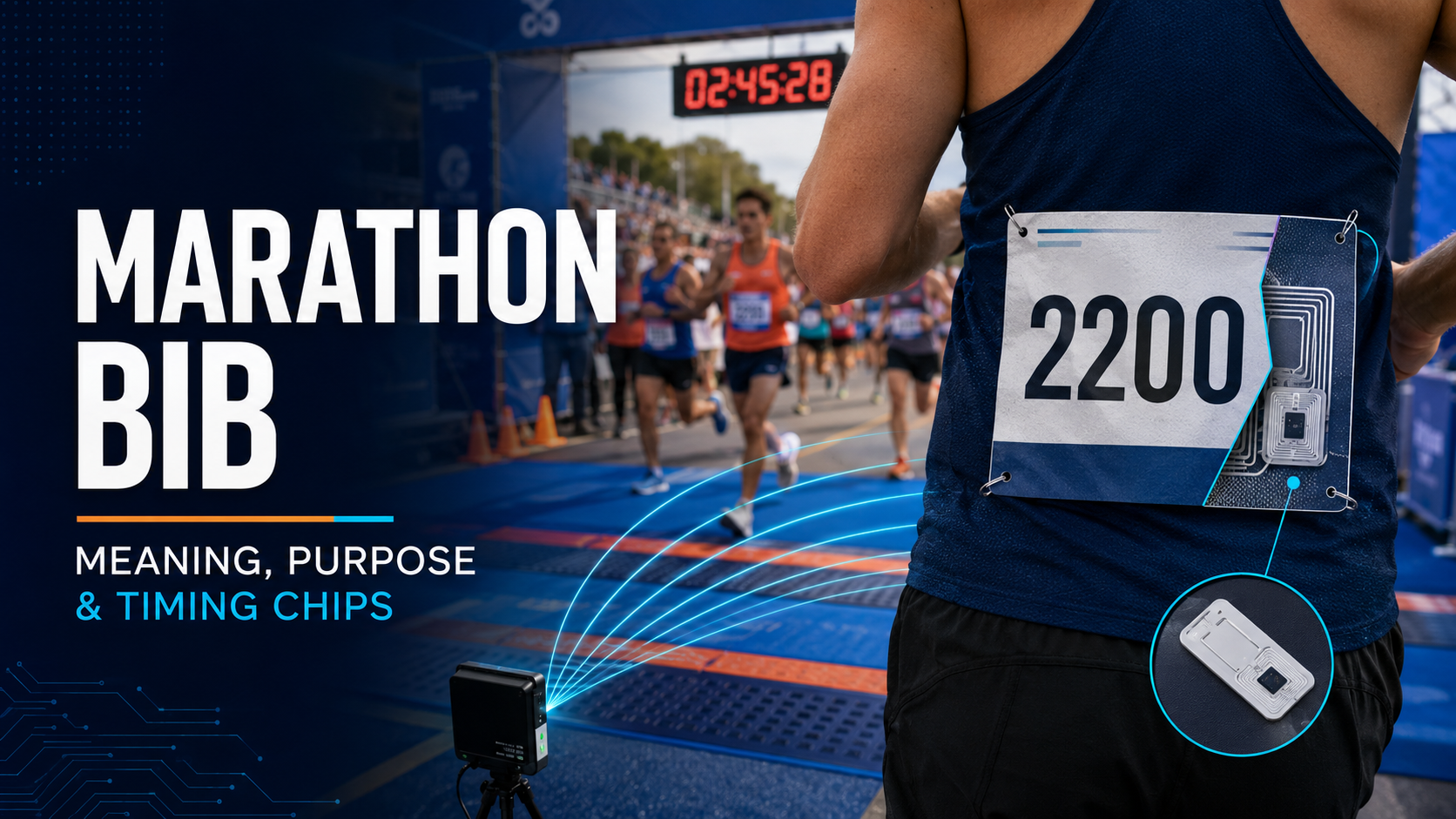
Discover the meaning and purpose of a marathon BIB, what information it contains, how RFID timing chips record race times, and why wearing your BIB correctly is essential for accurate results.
Introduction
If you have ever participated in a marathon, half marathon, 10K or 5K run, you have probably received a numbered sheet to attach to the front of your T-shirt. This is called a race BIB or marathon BIB or BIB.
A marathon BIB is much more than a printed race number. It identifies the runner, connects the participant to the event database and may contain an RFID timing chip that records start, finish and intermediate split times. This BIB is printed on Tyvek Paper which is non terable and waterproof.
In this guide, we explain the meaning of a marathon BIB, its purpose, the information printed on it and how timing chips calculate race results.
What Is the Full Form of BIB in a Marathon?
The commonly used full form is:
BIB – Bib Identification Number
However, “bib” was originally not an acronym. The name comes from the bib-like garment or panel worn on the front of the body. Since the race number identifies the participant, the terms race BIB, BIB number and runner BIB have become standard in running events.
In simple words:
A marathon BIB is the official race-identification number assigned to a registered participant.
Every runner normally receives a unique BIB number for a particular event and category.
What Is a Marathon BIB?
A marathon BIB is a printed race number worn by a participant during a running event. It is generally made from lightweight, water-resistant and tear-resistant material.
Depending on the event, the BIB may be:
Pinned to the front of the runner’s T-shirt
Attached using magnetic BIB holders
Fixed to a race belt
Integrated with a disposable RFID timing chip
Colour-coded according to race category or starting wave
The BIB should remain clearly visible throughout the race. It helps officials, photographers, volunteers, medical personnel and timing teams identify the participant.
What Information Is Printed on a Race BIB?
The information printed on a marathon BIB varies by event, but it may include:
Event name and logo
Participant’s BIB number
Runner’s name
Race category or distance
Starting wave or corral
Category colour code
RFID timing chip
QR code or barcode
Emergency contact number
Medical-information field
Event date
Cut-off time
Sponsor logos
Baggage tag
Meal or refreshment coupon
Event helpline number
Some events use detachable sections for baggage submission, refreshments or transport.
What Is the Purpose of a Marathon BIB?
1. Runner identification
The BIB is the runner’s primary identification during the event. Officials can use it to connect the participant with their registration record.
2. Race timing
In timed events, an RFID chip may be attached to the back of the BIB. Timing systems detect the chip when the runner crosses the start, split and finish points.
Passive UHF transponders attached to race BIBs are commonly used for mass-participation events such as marathons and road races.
3. Category verification
BIB colours or number series can identify different categories, such as:
Full Marathon
Half Marathon
10 KM
5 KM
Fun Run
Elite runners
Pacers
Corporate participants
This helps event officials direct runners towards the correct holding area, start wave and route.
4. Safety and emergency support
A BIB may contain emergency information or connect officials to a participant’s stored profile. If a runner requires medical assistance, authorised personnel can use the BIB number to identify the runner.
Participants should complete the emergency-information section when one is provided.
5. Photography and photo identification
Race photographers often use visible BIB numbers to organise and search event photographs. Some platforms also use optical character recognition or facial-recognition technology to help runners find their race photos.
6. Result verification
The BIB number connects the runner with their timing reads, race category, age group and final result. It may also be used to investigate missing timing data or route-checkpoint discrepancies.
7. Access control
Event teams may check the BIB before allowing participants into:
Starting corrals
Race routes
Hydration zones
Finisher areas
Refreshment sections
Medal-distribution counters
Baggage counters
A participant should never exchange or transfer a BIB without official permission.
What Is a Timing Chip?
A timing chip is a small electronic transponder used to identify a runner when they cross an official timing point.
In many road races, the chip is:
Attached to the back of the BIB
Built into the BIB material
Mounted on a foam spacer
Supplied as a shoe tag
Worn around the ankle in selected events
Race-timing providers offer disposable BIB tags as well as reusable active and passive transponders.
The timing chip does not generally work like a GPS tracker. It does not continuously track the runner’s live location. Instead, it records the runner when the chip passes an installed timing antenna or mat.
How Does an RFID Marathon Timing Chip Work?
RFID means Radio-Frequency Identification.
The complete timing process works as follows:
Step 1: Chip allocation
Before the event, every timing chip is assigned or mapped to a participant’s BIB number.
The database may connect:
Chip ID → BIB Number → Participant → Race Category
With many passive timing systems, the chip number may be encoded to match the BIB number, making result allocation easier.
Step 2: The runner wears the BIB
The runner attaches the BIB to the front of their outermost clothing. The timing chip must remain attached and unobstructed.
A foam spacer is sometimes placed behind a BIB transponder because the water content of the human body can absorb radio frequencies and affect detection.
Step 3: The runner crosses a timing point
Timing mats, ground antennas or side antennas are installed at locations such as:
Start line
Intermediate split points
U-turn points
Checkpoints
Finish line
When the runner crosses the timing point, the system detects the chip’s unique identification code.
Step 4: The timing system records the read
The decoder records information such as:
Chip identification
Timing-point name
Exact detection time
Reader or antenna information
The data is then transferred to the race-timing software.
Step 5: Timing software calculates the result
The software connects the detected chip with the participant’s registration record and calculates:
Start time
Finish time
Net time
Gun time
Split times
Pace
Overall rank
Gender rank
Age-category rank
Step 6: Results are published
After validation, results may be published on:
Event website
Timing partner’s website
Sportifi runner dashboard
Live leaderboard
Finisher-certificate page
Transponder timing is recognised within the technical framework for road-running competitions, although organisers must maintain appropriate backup and verification systems.
Passive vs Active Timing Chips
Passive timing chips
Passive chips do not contain their own battery. They are activated when they enter the radio-frequency field created by the timing equipment.
They are commonly used for:
Marathons
Half marathons
10K and 5K races
Mass-participation running events
Large road races
Advantages include:
Lightweight construction
Lower cost
Disposable format
Easy integration with race BIBs
Suitable for thousands of participants
Active timing chips
Active chips contain a battery and continuously transmit or respond with a stronger signal. They are usually reusable and may provide greater precision in specialised events.
They are often used for:
Triathlons
Cycling races
Motorsport
Mud races
High-speed events
Events requiring reusable ankle tags
The most suitable system depends on the sport, participant volume, expected speed, route conditions and required accuracy.
What Is the Difference Between Gun Time and Net Time?
Gun time
Gun time begins when the official race starts, regardless of when an individual runner crosses the start line.
Gun Time = Finish Clock Time – Official Start Time
For example, if the race begins at 6:00 AM and a runner finishes at 7:05 AM, the gun time is 1 hour 5 minutes.
Net time
Net time begins when the individual runner crosses the start timing mat and ends when the runner crosses the finish timing mat.
Net Time = Individual Finish Time – Individual Start Time
If the runner crosses the start line two minutes after the official flag-off and reaches the finish at 7:05 AM, the net time would be 1 hour 3 minutes.
Net time is particularly useful in large races where runners may take several minutes to reach the start line.
Official prizes and rankings may be decided using gun time or another method specified in the event rules. Participants should read the event’s prize and timing policy before race day.
Why Are There Timing Mats at Intermediate Points?
Intermediate timing points help organisers:
Calculate split times
Verify that runners followed the correct route
Confirm U-turn completion
Detect missed checkpoints
Identify suspicious or incomplete results
Monitor runner progress
Improve event safety
Produce more detailed performance data
For example, a half-marathon route may have timing points at the start, 5 KM, 10.5 KM U-turn and finish.
If a mandatory timing read is missing, the result may be placed under review. A missing read does not always mean that the runner cheated; it can also result from incorrect BIB placement, chip damage or a temporary reading issue.
How Should You Wear a Marathon BIB?
For accurate timing and easy identification:
Wear the BIB on the front of your T-shirt
Keep the complete BIB visible
Attach it securely at all four corners
Wear it on your outermost layer
Do not cover it with a jacket or hydration belt
Do not fold or crumple the BIB
Do not remove the timing chip
Do not pierce, cut or damage the chip
Do not exchange the BIB with another runner
Confirm that the printed details are correct
Always follow the event’s specific BIB instructions because chip designs and timing systems may differ.
Common Marathon BIB Mistakes
Wearing the BIB on the back
Unless specifically instructed by the organiser, the race BIB should normally be worn on the front.
Covering the BIB
A jacket, waist pouch or hydration belt can hide the number and may interfere with photography, identification or timing.
Folding the timing chip
Folding or crushing the chip can damage its antenna and reduce detection reliability.
Removing the chip
The chip should remain attached exactly as provided. Do not try to reposition it without instructions from the timing team.
Using another participant’s BIB
This creates incorrect results and can cause serious safety problems because the emergency information belongs to a different person.
Changing category without approval
A runner should not use a BIB issued for another race distance or wave. Request an official category change before the event.
What Should You Check When Collecting Your BIB?
At the BIB Expo, confirm:
Your name
BIB number
Race category
Gender and age category
Starting wave
Timing-chip attachment
T-shirt size
Emergency details
Baggage tag
Reporting and flag-off time
BIB-wearing instructions
Report any error immediately. Corrections become more difficult once participant data is locked for timing and result processing.
Does Every Marathon BIB Have a Timing Chip?
No. Timed races usually provide a BIB with a timing chip or a separate transponder. Fun runs and non-timed categories may use BIBs only for identification.
Before registering, check whether the category is marked as:
Timed
Chip timed
Non-timed
Fun run
Can a Timing Chip Track a Runner’s Live Location?
A standard RFID race chip does not provide continuous GPS tracking. It records the runner only when they cross installed timing points.
An event that provides live GPS tracking requires a separate device, mobile application or GPS-enabled tracking system.
What Happens to the Timing Chip After the Race?
Disposable chips attached to the BIB generally do not need to be returned. Reusable shoe, ankle or active tags must normally be returned after finishing.
Failure to return a reusable chip may result in a replacement charge. Always follow the organiser’s instructions.
Frequently Asked Questions
What is the full form of BIB in a marathon?
The commonly used expansion is Bib Identification Number. However, “bib” originally refers to the bib-like race-number panel worn on the front of the body.
What is a BIB number in running?
A BIB number is the unique race number assigned to a participant for identification, timing, photography and result management.
Where should a runner wear the BIB?
The BIB should generally be worn on the front of the outermost T-shirt or running garment, unless the organiser provides different instructions.
Is the timing chip inside the BIB?
In many timed running events, a disposable RFID timing chip is attached to the back of the BIB. Some events provide separate shoe or ankle tags.
Can I fold my marathon BIB?
You should not fold the BIB, especially across the timing chip. Folding may damage the chip or reduce its readability.
Can I give my BIB to someone else?
A BIB should not be transferred without official approval. Unauthorised transfer causes incorrect results and can create medical and safety risks.
What happens if my chip is not detected?
The timing team may check backup timing lines, photographs, videos, manual records and intermediate reads. The result may remain under review until it is verified.
Is net time the same as chip time?
In most mass-participation races, chip time generally refers to the runner’s net time—from crossing the start timing point to crossing the finish timing point.
Conclusion
A marathon BIB is the runner’s official identity throughout a race. It connects the participant with their category, timing data, photographs and final result.
When a timing chip is attached, the BIB becomes part of a complete RFID race-timing system. Each time the runner crosses an installed timing point, the system records the chip, connects it to the runner’s profile and calculates the relevant race time.
Wearing the BIB correctly is therefore essential for accurate results, clear identification and runner safety.
Find Your Next Running Event
Looking for your next 5K, 10K, half marathon, full marathon or virtual run?
Explore upcoming running events and register securely through Sportifi—India’s Complete Sports Event Platform.
Explore Running Events: www.sportifiindia.com
For any query related to taking timing services for marathon visit https://www.sportifitiming.com/